Margini
Three Acts of Sugar — Act II: The Encounter
Two hands, two countries, one single material — Patrizia Laureti and Peggy Porschen
18 October 2026
58 readers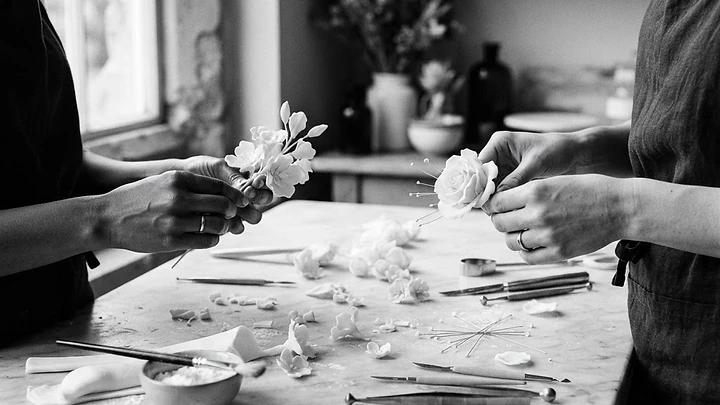
1. Hands have no nationality
Hands have no nationality. They know no borders, require no passports, and do not distinguish one language from another. They know the weight of the material, its resistance, the moment to insist, and the moment to stop. There are crafts that are passed down through words. And others that are truly understood only by observing a gesture. Pastry arts belong to both. But when it enters the realm of artistic decoration, something changes. Sugar ceases to be merely an ingredient and becomes a medium for expression. It can imitate a petal, hold a nuance, or build a shape that seems to defy gravity.
In Rome, Patrizia Laureti works on this boundary. In London, Peggy Porschen has built a recognizable universe around the same material. Two paths, two sensibilities, two ways of interpreting a language that does not belong exclusively to anyone. We are not recounting an actual meeting that took place between these two professionals. We are imagining an encounter between two visions. And sometimes, that is precisely how the most interesting reflections begin.
2. A German girl and a British art
Peggy Porschen grew up in Germany, in a small town near Cologne. Since she was a child, she loved baking. But it was during her travels to London, while working as a flight attendant, that she discovered the British tradition of artistic cake decoration. That encounter changed the course of her life. In 1998, she moved to London to study at Le Cordon Bleu, earning her Grand Diplôme in cuisine and pastry in 1999. After gaining professional experience, she founded her own business in 2003. In 2010, she opened her famous Parlour in Belgravia. Pink, flowers, seasonal window displays, the precision of the decorations, and the romantic atmosphere have become part of a distinct identity. But it would be reductive to describe Peggy Porschen solely through aesthetics. Behind a floral composition lie study, technique, repetition, organization, and a deep knowledge of ingredients. Visual lightness is often the result of work that is anything but light.
3. Rome and London: two interpretations of sugar
The journey of Patrizia Laureti begins with a different memory. She speaks of a childhood spent beside a grandfather who was a pastry chef. An experience that brought her closer to craftsmanship, taste, and the transformation of ingredients. In her workshop, Luxury Cake Design & Bakery, the language of Italian tradition meets that of international cake design. Laureti states that she personally produces the sugar paste used for decorations, without preservatives or additives, and seeks a balance between the quality of the raw material and artistic freedom. This question is important. Because a cake can be an extraordinary object to behold and a disappointing dessert to eat. Or it can manage to reconcile both dimensions. This is where Rome and London become interesting. Not as cities to be pitted against each other, but as places where the same art takes on different accents.
4. The flower that knows not its own origin
Let us imagine two sugar flowers. The first made in a Roman workshop. The second in a London pastry shop. Both require precision, attention to proportions, knowledge of color, and the ability to thin the material without destroying it. From a distance, they might seem similar. Up close, they would reveal different decisions. A petal might be intentionally irregular. A color might be almost imperceptible. A composition might seek botanical accuracy or evoke a flower that does not exist in nature. Technique allows one to build. Sensibility decides what to build. And it is precisely in this space that craftsmanship becomes a personal language.
5. The problem of beauty
There is a question that accompanies every form of artistic pastry. How beautiful should a cake be? The seemingly simplest answer would be: as much as possible. But beauty can become a problem when it forgets the reason why a cake exists. A cake is not a sculpture destined to remain intact. It is an object waiting to be sliced. Its destiny is to disappear. And this condition makes it different from many other decorative works. The artist works knowing that someone will interrupt the composition with a knife. The pastry chef must ensure that this gesture does not represent a loss, but the fulfillment of the work. A truly successful cake does not betray the promise built before the eyes when it arrives at the palate.
6. The cake that could be born from the encounter
Let us try to imagine a joint project. Not a documented collaboration, but an exercise in imagination. A cake that unites the sensibility of Italian pastry with British decorative romanticism. A measured structure, a floral composition capable of surprising without taking over the entire scene. Inside, recognizable flavors, balanced textures, and a sweetness that does not overpower the other ingredients. Outside, the story of something that could not be born in exactly the same way in two separate workshops. It would not be an Italian cake dressed as an English one. Nor an English cake with an Italian filling. It would be a third language. Perhaps this is the most interesting result of any authentic exchange: not the sum of two styles, but the birth of a new possibility.
7. Learning without imitating
Contemporary pastry lives on images. Photographs travel, styles become recognizable, and trends cross continents in seconds. This has made an extraordinary circulation of ideas possible. But it has also produced a temptation: to confuse learning with reproduction. Looking at a Peggy Porschen cake and attempting to rebuild it can be a technical exercise. Understanding why that cake works, however, is deeper work. The same applies to the creations of Patrizia Laureti. Replicating a decoration is not enough to understand the project behind it, its relationship with taste, its purpose, and its meaning. Influence becomes fertile when it passes through the sensibility of the recipient. Otherwise, it remains a copy. And a copy, even when technically perfect, always tells less than an imperfect original.
8. The value of a difference
Often, people try to establish which school is better. The Italian or the British one. Traditional pastry or cake design. Taste or form. These are juxtapositions that overly simplify a complex trade. The professional history of Peggy Porschen arises from the encounter between European training and the British tradition of sugarcraft. The work declared by Patrizia Laureti explicitly seeks the union between the taste of Italian pastry and the aesthetics of Anglo-American sugar art. Both, therefore, already tell of a contamination. Differences are not obstacles to be eliminated. They are resources to be understood.
9. The gesture that is transmitted
An artisan trade possesses a particular memory. Not all of it can be written down. One can explain how to prepare sugar paste. One can specify temperatures, quantities, times, and tools. But something remains that is learned only through experience. The pressure of the fingers. The way a hand accompanies a curve. The decision to remove material rather than add it. The moment one realizes that a flower is finished. These are forms of knowledge that pass through the body even before the word. This is why teaching and the transmission of the craft represent an essential part of gastronomic culture. One does not pass down only recipes. One transmits a way of looking.
10. Two workshops, one table
Let us imagine Rome and London sitting at the same table. No competition. No need to prove superiority. Only two professionals observing each other's work. What would the Roman pastry chef ask the London one? What would the London cake designer be curious about regarding the Italian workshop? Perhaps the answer would not concern colors, techniques, or tools. Perhaps it would concern something much simpler. Who are you preparing this cake for? Because, beyond appearances, celebratory pastry always has an intended recipient. It speaks of weddings, birthdays, anniversaries, desires, memories. Its function is not only nutritional. It is also emotional.
11. The difference between a border and a distance
A border separates. A distance can be crossed. Between Rome and London, there are kilometers, traditions, and different habits. But cultural distance can become the place where curiosity is born. And curiosity, when it meets competence and respect, becomes knowledge. Two professionals do not need to work together physically for the comparison of their works to produce reflection. It is enough to observe without wishing to judge immediately. After all, gastronomic culture does not grow only when it invents something new. It also grows when it learns to recognize the value of what already exists elsewhere.
12. What remains when two hands separate
When a cake is cut, its shape begins to disappear. Flowers can be removed, the composition loses its balance, the surface is interrupted. But that does not mean the work was done in vain. The experience remains. The memory of those who saw it arrive remains. The taste remains, if the pastry chef knew how to attribute the same importance to it as to the beauty. Above all, the gesture of someone who built something for another person remains. Patrizia Laureti and Peggy Porschen represent two interpretations of this possibility. They do not have to be identical. They do not even have to truly meet for their work to be observed through the same question. What makes a dessert a work capable of belonging to memory, despite being destined to disappear? Perhaps the answer does not lie in the perfection of the decoration. But in what happens when someone finally tastes a slice.
IN THE NEXT ARTICLE — THREE ACTS OF SUGAR, ACT III: THE BORDER. Sunday, October 25, 2026. Where does decoration end and pastry begin? And above all: is there a point where beauty stops serving taste and starts dominating it? To answer, we must leave Rome. And reach London.
Sources and further reading
PATRIZIA LAURETI — LUXURY CAKE DESIGN
• Biography and professional career — luxurycakedesign.it/about
• The workshop and philosophy of work — luxurycakedesign.it/lab
• Wedding cake and artistic decorations — luxurycakedesign.it/cakes
• Materials and interpretation of Sugar Art — luxurycakedesign.it/cakes
PEGGY PORSCHEN — LONDON
• The Peggy Porschen Story — peggyporschen.com
• About Us — Peggy Porschen — peggyporschen.com/about
• Le Cordon Bleu — Peggy Porschen Alumni Story — cordonbleu.edu
Have you read today's daily?Read it hereFirma del Cuoco
Chef GodeauSartoria Gastronomica
You may also like

Ricette
Pasta Aglio, Olio, Peperoncino e Prezzemolo — Ancient Simplicity
From the charcoal burners' fire to the Chef's table: a humble recipe that speaks of the south, of patience, and the art of never draining pasta
18 Oct 2026

Margini
Salt as the first word
Dosing, salting, and letting rest: the Japanese technique that rewrites the Western balance.
13 Oct 2026

Margini
New oil and the time that stands still
How to capture the sharpness of freshly pressed oil and transform it into a bridge between seaweed and citrus.
3 Oct 2026