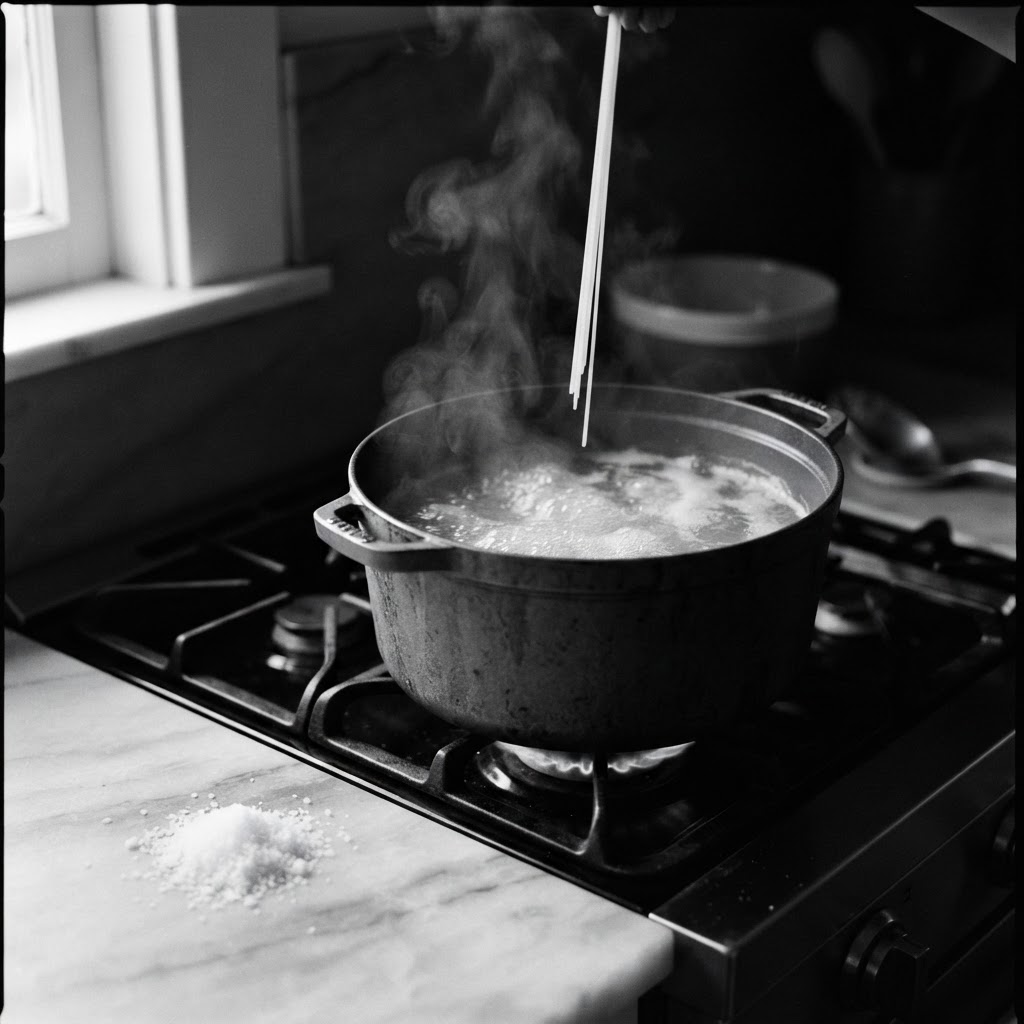
It is not a renunciation and it is not a universal rule: it is a different way of constructing the balance of a dish
«Pasta water must be as salty as the sea.» It is one of the most repeated phrases in Italian cuisine. It is passed down almost as if it were a law, along with the obligation to use plenty of water, wait for the boil, and drain the pasta perfectly al dente. I, on the other hand, do not add salt. Not because I consider salt an enemy, nor to argue that everyone should cook in the same way. Not putting it in the water is a personal and conscious choice: I prefer to build savoriness through the sauce and let the ingredients determine the final dose. A decision like this, however, only works if there is a precise flavor project behind it. Eliminating salt without modifying the rest of the recipe simply produces a bland pasta.
The difference is all here: it is not about taking away, but about redistributing.
First act: the accusation The accusation against pasta cooked without salt is immediate: «The pasta will have no flavor.» The objection is correct, at least in part. During cooking, pasta absorbs water and, if it is salted, it also absorbs a certain amount of sodium. The salt does not all stay in the pot: a part actually enters the pasta. A study published in Food Chemistry analyzed different cooking conditions. A 140-gram portion of pasta cooked without salt contained less than 5 milligrams of sodium, while the same amount cooked in salted water contained, depending on the concentration used, between 247 and 490 milligrams. As the salt in the water increased, the sodium absorbed by the pasta also increased linearly. Therefore, salting the water really serves to flavor the pasta from the inside. Denying this would be technically wrong. The point is not to establish whether the traditional method works. It works. The real question is another: are we sure that every dish needs to receive salt from both the pasta and the sauce?
Second act: the defense A pasta is almost never eaten alone. It is seasoned with tomato, olives, capers, anchovies, cheeses, mollusks, cured meats, pan drippings, preserves, toasted bread, or other ingredients that can contain a natural savoriness or one added during processing. If the pasta has already absorbed salt during boiling and then meets a very savory sauce, the result can lose balance. Often, one tries to correct it by adding water, more tomato, fat, or a sweet component. But at that point, we are intervening on an imbalance that we created earlier. I prefer to proceed in the opposite direction. I cook the pasta in unsalted water and let it gradually absorb the sauce during the final phase in the pan. In this way, the savoriness arrives together with the aromas, and I can evaluate it until the very last moment. I do not renounce taste. I choose when to let it in.
◆
Salt is not the only tool for flavor One of the most common mistakes consists of confusing taste with savoriness. When a dish seems dull, the first reaction is often to add salt. Sometimes it works, but in many cases, what is missing is not really sodium. It may be missing acidity, fragrance, toastiness, temperature, texture, or a bitter component capable of creating contrast.
Salt makes taste more evident, but it cannot invent complexity. A well-constructed dish can simultaneously use different tools: > The savoriness offers immediacy and persistence. It can come from olives, capers, anchovies, aged cheeses, preserves, and other ingredients. > The acidity stimulates salivation, lightens the perception of fat, and makes the bite more lively.
It can come from tomato, citrus, wine, vinegar, or fermentations. > The aromatic herbs expand the perception of the dish through scent. Basil, fennel, thyme, and marjoram do not contribute significant amounts of salt, but they can make its absence less evident. > The toasting creates depth.
A mollica atturrata, a toasted pine nut, or a heated spice introduce sensations that salt, alone, could not produce. > The bitter component, when controlled, prevents sweetness and fat from making the dish monotonous. > The umami increases gustatory fullness and prolongs flavor, without necessarily coinciding with greater salinity. Taste is an architecture. Salt is a part of the construction, not the entire building.
◆
Herbs do not produce salt On this point, it is necessary to be precise. Basil, fennel, and other aromatic herbs do not make the salt "come out" of the ingredients and do not possess an amount of sodium capable of truly salting a pasta. Their contribution is different, but no less important. A large part of what we call flavor is born, in fact, from the encounter between taste and smell.
Aromatic molecules reach the nose even while we chew and expand the overall perception of the bite. A dish rich in aromas can therefore be complete even with less salt. Not because the herbs have created savoriness, but because they have occupied the sensory space that we often try to fill by adding sodium. They do not chemically replace salt. They gastronomically reduce its necessity. It is a fundamental difference.
The decisive test happens in the pan Cooking pasta without salt requires particularly attentive mantecatura. If it is drained and then simply covered with the sauce, the seasoning will remain on the surface and the inside of the pasta may be neutral. To avoid this separation, one must stop the boiling a few minutes earlier and complete the cooking directly in the sauce. The pasta, still very al dente, will absorb part of the sauce's liquid.
Together with the starch-rich cooking water, it will contribute to creating an emulsion capable of enveloping its surface. In this way, it does not simply absorb salted water: it absorbs tomato, aromas, oil, and the savoriness of the ingredients used in the recipe. The passage in the pan is therefore not a scenic finish. It is the moment in which the true balance of the dish is established. ### The case of mezze maniche with three tomatoes In my recipe for mezze maniche with three tomatoes, the water contains no salt. The gustatory construction happens through distinct elements:
• peeled tomatoes create the soft and slightly acidic base;
• datterini bring freshness and natural sweetness;
• confit cherry tomatoes develop concentration;
• honey, used in minimal quantities, rounds out the acidity without turning the dish into a sweet preparation;
• basil and fennel widen the aromatic profile;
• the mollica atturrata and pine nuts introduce toastiness;
• the Taggiasca olives provide the real savoriness. The olives only enter in the final phase. Their presence must be calculated with attention, because they are the ones supporting a large part of the saline balance. The pasta, finishing its cooking together with the three tomatoes, gradually absorbs the sauce. The savoriness no longer arrives from a uniform and anonymous water, but from recognizable ingredients. Each element retains its own voice and, at the same time, participates in the overall construction.
The strongest objection: the inside will remain neutral It is true: a pasta cooked entirely in unsalted water and seasoned only at the end can remain slightly flavorless at the center. The solution does not consist of denying the problem, but in modifying the method. The pasta must be transferred to the pan before the normal cooking point. It must find a sufficiently fluid sauce and have the time to absorb it.
The starchy water must be added in reduced quantities and the base must be moved continuously. The thicker the pasta, the greater the attention required. Not all recipes lend themselves in the same way. A very light seasoning almost devoid of savory elements might need a small amount of salt in the water.
A sauce rich in olives, capers, anchovies, or cheeses can instead allow one to eliminate it completely. Not salting must not become a dogma opposite to the traditional dogma. Cuisine does not need new absolute rules. It needs awareness.
Tasting in sequence, not just at the end When you don't salt the water, tasting becomes even more important. You need to test the sauce separately, then taste it with a small piece of pasta, and finally evaluate it after the addition of the main savory ingredient. An olive eaten alone can seem very salty. Distributed between pasta, tomato, and mantecatura water, it changes intensity completely.
The same goes for capers, anchovies, and cheeses. Savoriness is not measured only in grams: it is measured in distribution. A small amount concentrated in a single point produces a different effect than the same amount dissolved uniformly in the dish. For this reason, I prefer to add some savory ingredients at different times. A part can go into the base to diffuse the flavor; another can be inserted at the end, leaving small peaks of intensity in the bite. The balance does not necessarily have to be flat and uniform. It can have a rhythm.
When my method does not work Not putting salt in the water is not automatically a refined choice. If the sauce is weak, if the mantecatura lasts only a few seconds, or if the pasta is served separate from the sauce, the result will simply be incomplete. This method does not work well when:
• the sauce is very dry and cannot be absorbed;
• the pasta is cooked completely in water and seasoned only on the plate;
• ingredients capable of providing savoriness are missing;
• salt, acidity, aromas, and toastiness are eliminated simultaneously;
• one does not taste during preparation. Under these conditions, it is better to moderately salt the water. Cuisine should not defend an idea at the expense of the result.
When it actually makes sense Cooking without salt becomes interesting when the sauce already possesses its own gustatory structure. It works particularly well with:
• olives and capers;
• anchovies and preserved fish;
• naturally savory mollusks;
• aged cheeses;
• concentrated stocks;
• preserved tomatoes already containing salt;
• flavorful breadcrumbs and breads;
• fermented ingredients. In these preparations, the unsalted water offers a neutral space in which to better dose all the other elements. Initial neutrality is not an absence. It is a possibility of control.
It is not a battle against salt Salt possesses an ancient and fundamental gastronomic value. It preserves, modifies textures, extracts water, attenuates some bitter sensations, and makes numerous flavors more readable. Eliminating it completely from every preparation would be a stretch. My method concerns a specific gesture: not adding it automatically to the pasta water when I know that the sauce already possesses the tools necessary to complete the dish.
Automatism is the real point to be questioned. Many people salt the water without considering the type of sauce, the presence of cheese, the quantity of olives, or the concentration of the base. They follow a habitual dose and try to correct the result only at the end. I prefer to start from zero and build progressively. It does not mean it is the only correct path. It means that every choice should have a reason.
The verdict Salt in water really flavors the pasta. Tradition, on this point, has a concrete basis. But it is not mandatory to use it in every recipe. You can cook pasta without salt when the sauce has been designed to provide savoriness, perfume, acidity, toastiness, and depth.
It is indispensable, however, to finish the cooking in a pan and taste continuously. Aromatic herbs do not salt. Basil does not chemically replace sodium, and fennel does not transfer a mysterious natural savoriness. Both, however, expand the olfactory experience and contribute to making the dish more complex.
Olives, capers, anchovies, or cheeses provide the actual savoriness. Tomato brings acidity and umami. Toasting adds depth. The mantecatura unites everything. The result must not seem like a pasta from which something has been taken away. It must be a dish in which no one feels the need to add it. That is why I do not put salt in the pasta water: not to subtract taste, but to decide with greater precision where that taste should come from.