Margini
Salt as the first word
Dosing, salting, and letting rest: the Japanese technique that rewrites the Western balance.
13 October 2026
157 readers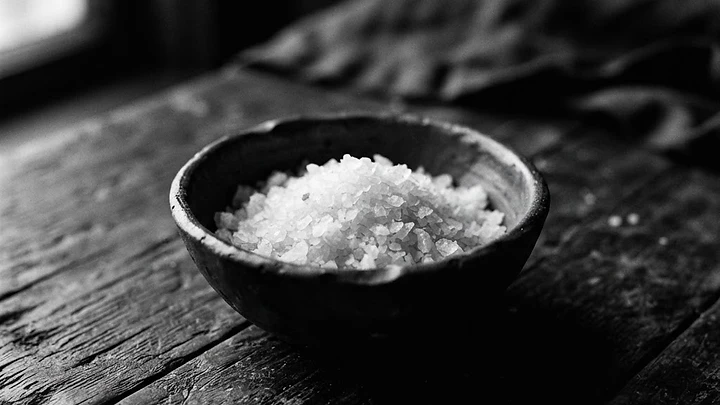
Salt is not a seasoning; it is a decision I make before I even light the fire. At the Sartoria Gastronomica, I work with three distinct salts: French fleur de sel for finishing, whole sea salt for long marinades, and a light smoked salt to provide depth without true smoking. The fundamental difference lies in the grain size: a coarse crystal releases sapidity progressively, while a fine salt causes it to explode instantly only to then fade away. For raw vegetables, such as fennel sliced paper-thin with a mandoline at 2 millimeters, I use only fleur de sel, applied by hand just minutes before service.
The technique I stole from Japanese cuisine is shiozuke, the rapid salting of vegetables before cooking or fermentation. I cut the cabbage into thin julienne, sprinkle it with 2% of its weight in salt, massage it with my hands for exactly three minutes, and let it rest under weight for forty minutes. Osmosis extracts excess water, concentrates the natural sugars, and prepares the plant fiber for a subsequent thermal shock, whether it is direct-contact grilling or tempura at 170°C. This step, often skipped in Western cooking, is what makes the difference between an aqueous vegetable and one that maintains structure in the mouth.
On fish, salting always precedes cooking, never follows it. For a 150-gram sea bass fillet, I apply 8 grams of fine salt per side, let it sit for fifteen minutes at room temperature, then dry it with paper towels before searing it in the pan. Salt applied in advance slightly denatures the surface proteins, creates the film that promotes the Maillard reaction, and prevents residual water from steaming instead of browning. It is the same logic as the Anglo-Saxon dry brining, though applied with shorter times because fish, unlike meat, does not tolerate prolonged salting without losing its texture.
The salt-acid balance is where the real game between East and West is played. In my modified ponzu sauce, I use 100 ml of yuzu juice, 80 ml of light soy sauce, 20 ml of rice vinegar, and one gram of extra salt to correct the soy when it is too sweet. Here, the salt does not add direct sapidity, but rather extends the perception of acid on the tongue, making it less sharp and more round. I apply the same principle to a citrus and fennel salad: a pinch of salt on the fruit before dressing it with extra virgin olive oil shortens the perception time of the acidity and brings out the sweet component.
For fermentation, salt is the invisible architect. In my vegetable kimchi made of white turnip, I use a 3.5% brine, calculated on the total weight of water and vegetables, because below 2% I risk unwanted contamination and above 5% I block lactic fermentation. I let it ferment at 18°C for five days, checking the pH, which must drop below 4.
2 to ensure stability and safety. Here, salt is not taste; it is selection: it decides which bacteria survive and which die, and consequently, it decides the final flavor. The practical advice is this: always weigh salt in grams, never by the teaspoon, and create a mental scale based on the percentage relative to the weight of the ingredient, not to the palate of the moment. Start from 2% for vegetables to be massaged, 3.
5% for fermentations, and 1% for raw fish marinated for a few minutes. Once you have these numbers in hand, improvising becomes precise rather than random.
Have you read today's daily?Read it hereFirma del Cuoco
Chef GodeauSartoria Gastronomica
You may also like

Margini
Three Acts of Sugar — Act II: The Encounter
Two hands, two countries, one single material — Patrizia Laureti and Peggy Porschen
18 Oct 2026

Ricette
Pasta Aglio, Olio, Peperoncino e Prezzemolo — Ancient Simplicity
From the charcoal burners' fire to the Chef's table: a humble recipe that speaks of the south, of patience, and the art of never draining pasta
18 Oct 2026


Margini
New oil and the time that stands still
How to capture the sharpness of freshly pressed oil and transform it into a bridge between seaweed and citrus.
3 Oct 2026