Ricette · Margini
Pasta Aglio, Olio, Peperoncino e Prezzemolo — Ancient Simplicity
From the charcoal burners' fire to the Chef's table: a humble recipe that speaks of the south, of patience, and the art of never draining pasta
18 October 2026
52 readers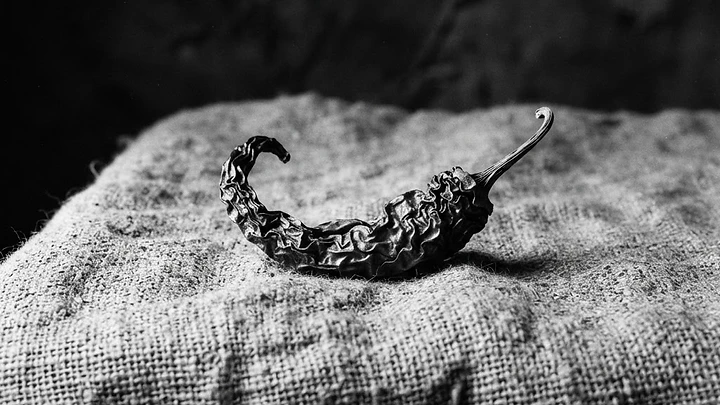
Pasta aglio, olio e peperoncino. Ten letters, three ingredients, a universe. It is the dish every Italian has cooked at least once in their life, at night, with the refrigerator nearly empty and a craving for something warm. Yet, behind this apparent poverty hides one of the most ancient and philosophical recipes of our tradition: a dish that speaks of fire, of oil, of time. The origin of this pasta is lost among the roads of the Mezzogiorno, between Lazio and Abruzzo, between Campania and Sicily. Some trace it back to the charcoal burners of the Apennines, who worked at night and needed a hot, quick meal made from what could be preserved: garlic, oil, and dried peperoncino hanging from the rafters. Others link it to the seafaring tradition, where olive oil replaced the butter of the north and peperoncino warmed bodies chilled by the sea.
But it is in Sicily that this pasta finds its deepest soul. Here, where garlic meets the sun and peperoncino is almost a religion, pasta aglio e olio becomes something more: a dish of identity, a dish that tells who you are by the way you mince the garlic.
Chef Godeau has always considered this recipe an exercise in humility. «There is no dish more revealing of a cook’s character,» he says. «Those who know how to make aglio e olio well, know how to make everything. Because there are no tricks, there are no hiding places. There is only balance.»
The recipe that follows is his interpretation: enriched by fresh parsley, by muddica atturiata — the toasted Sicilian breadcrumbs for which you can find the dedicated recipe in the Chef's Notebook — and by a fundamental gesture: cooking the garlic with a little vegetable broth, which makes it sweet without burning it, fragrant without aggression. And then, the most important rule: the pasta is never drained. It is finished in the pan, with the heat turned off, because the pasta must drink the oil, not merely be greased by it.
THE INGREDIENTS (for 4 people)
• 400 g of durum wheat semolina spaghetti or linguine • 6 cloves of Aglio Rosso di Sulmona, thinly sliced • 8 tablespoons of high-quality extra virgin olive oil • 2 whole dried peperoncini, crumbled by hand (or a teaspoon of peperoncino powder) • A bunch of fresh flat-leaf parsley, finely chopped • 3 tablespoons of muddica atturiata (toasted breadcrumbs — see recipe in the Chef's Notebook) • 1 ladle of hot vegetable broth (celery, carrot, onion) • Coarse salt for the pasta water
THE PROCEDURE 1. Bring a large pot of salted water to a boil. When boiling, add the pasta. The water should be less salty than usual, because the pasta will finish seasoning in the pan.
2. In a large, heavy pan — made of iron or seasoned copper — pour the extra virgin olive oil cold. Add the sliced garlic and turn the heat to the lowest setting. The garlic must sweat, not fry: it must become golden, transparent, almost glassy. This requires patience, about 5 minutes.
3. When the garlic begins to smell fragrant, add the crumbled peperoncino. Do not let it burn: burnt peperoncino becomes bitter. 30 seconds over very low heat is sufficient.
4. At this point, pour a ladle of hot vegetable broth into the pan. This is the Chef’s secret move: the broth cooks the garlic gently, makes it tender, removes its aggression, and gives it a depth that oil alone could not provide. Allow the broth to reduce by half, still over very low heat.
5. Turn off the heat. Yes: turn off the heat. The pan must rest, with the fragrant oil thickening and the garlic continuing to cook in the residual heat. This is the moment for patience.
6. When the pasta has two minutes left of cooking, take a cup of the starchy cooking water and set it aside. Do not drain the pasta.
7. Using tongs or a spider strainer, transfer the pasta directly from the pot to the pan, bringing a little cooking water along with it. The pasta is not drained: it has migrated. This is the point. The starch in the water binds the oil, creates a cream, and ensures that every strand is coated, not just greased.
8. Turn the heat on for an instant — just long enough to toss the pasta in the pan, to make it jump, to let it drink the oil. Then turn it off again. The pan on, then off: this is the rhythm. 9. Add the fresh chopped parsley, the muddica atturiata, and a drizzle of raw olive oil. Mix with delicacy, like a caress, not a beating.
10. Serve immediately, with another handful of muddica atturiata on top and a whole sprig of parsley as a garnish. The pasta must be shiny, not greasy. Every strand must tell the story of the garlic, the peperoncino, and the broth.
THE PHILOSOPHY OF THE DISH
Pasta aglio e olio is not an emergency recipe. It is a meditation recipe. It requires the same attention as a risotto, the same care as a braised meat. The difference is that it does not forgive: there are no sauces to hide in, no garnishes to distract. There is only the pasta, the oil, and the hand of the one who makes it.
The muddica atturiata — breadcrumbs toasted in a pan with oil and garlic until golden — is the Sicilian gesture that transforms a poor dish into a noble one. It is not breadcrumbs: it is crunch, it is perfume, it is memory. It is what Sicilian grandparents used when there was no cheese, and that we use today because we know it is better than cheese. Parsley is not an addition: it is a necessity. Its fresh green cuts through the heat of the peperoncino, brightens the dish, and makes it alive. Without parsley, aglio e olio is a black and white painting; with parsley, it becomes a color painting.
And the cooking of garlic with vegetable broth? It is the secret the Chef learned from a cook in Trapani, who told him: «Garlic is not burnt; it is conquered.» The broth conquers it, softens it, and transforms it from warrior to poet. Serve this pasta warm, but not piping hot. Eat it in silence, or with those you know. It is a dish that deserves respect, because in every bite there is the south, patience, and the art of doing much with little.
Firma del Cuoco
Chef GodeauSartoria Gastronomica
You may also like

Margini
Three Acts of Sugar — Act II: The Encounter
Two hands, two countries, one single material — Patrizia Laureti and Peggy Porschen
18 Oct 2026

Margini
Salt as the first word
Dosing, salting, and letting rest: the Japanese technique that rewrites the Western balance.
13 Oct 2026

Margini
New oil and the time that stands still
How to capture the sharpness of freshly pressed oil and transform it into a bridge between seaweed and citrus.
3 Oct 2026