Produttori
The Andalusian Gardener: Olive Oil as a Bridge Between Two Coasts
How a small Andalusian producer taught me to treat EVO as a dashi, cold-extracting it and using it to bind seafood dishes in an oriental style.
13 October 2026
49 readers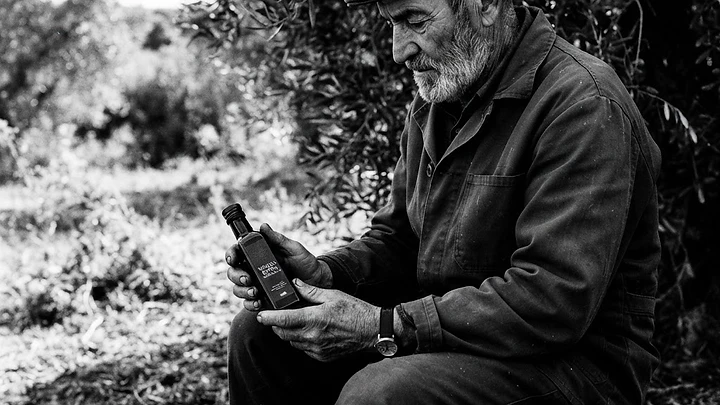
I met Manuel, the gardener I simply call "the Andalusian," at a masseria near Baeza, where he cultivates Picual olives on terraces overlooking the Sierra Mágina. His oil has an acidity level below 0.3%, extracted within two hours of harvest with cold pressing at 27°C: this time interval is decisive, because every hour of delay in milling increases oxidation and dampens the notes of green tomato and almond that I seek to balance the savoriness of the seaweed. I work with two batches from the same mill: one early-harvest, picked in early October, more bitter and spicy, with a Panel Test index above 6; the other late-harvest, rounder, which I use for finishing emulsions.
The technique I have developed combines Mediterranean extraction with a Japanese principle: kakushi-aji, the "hidden flavor." I whip the early-harvest oil with yuzu juice in a 4:1 ratio, then blend it cold in the Thermomix at low speed to avoid heating it above 30°C, otherwise it loses the volatile compounds linked to polyphenols, in particular the oleocanthal that gives that pungent sensation in the throat. The result is an emulsion that is stable for 48 hours in the refrigerator, which I use to glaze scallops seared for 45 seconds per side in a cast-iron skillet at 220°C. With seaweed, the register changes.
Rehydrated wakame must be blanched for 8 seconds in 90°C water and immediately cooled in ice water to set the chlorophyll and maintain cellular crunch; at this point, I dress it exclusively with the late-harvest oil, which is sweeter, because the bitterness of the early-harvest would cover the natural iodine of the seaweed. I use a ratio of 8 grams of oil to 100 grams of seaweed, always weighed on a precision scale: above this threshold, the oil saturates the taste buds and negates the saline contrast I desire on the palate. For the vegetable component, Manuel also provides me with dry-farmed Raf tomatoes, with a natural Brix level around 7-8 degrees. I cut them into concassé and marinate them for 20 minutes under vacuum with the early-harvest oil, a teaspoon of mirin, and grated yuzu zest: the vacuum accelerates the penetration of fats into the pulp, halving the time compared to marinating in an open bowl.
This concassé becomes the base of a amberjack tartare, where the acidity of the tomato and the bitterness of the oil balance the fat of the fish without the need for added citrus. The practical advice is this: never use a single oil for the entire dish. Always keep two bottles open, one early and bitter, one late and round, and choose based on the serving temperature of the dish: below 15°C, bitterness is attenuated and you need the early-harvest to provide structure; above 15°C, the late-harvest oil suffices on its own. Taste the oil by the teaspoon before each service, because oxidation changes the taste-olfactory profile week after week, even in a dark bottle.
Have you read today's daily?Read it hereFirma del Cuoco
Chef GodeauSartoria Gastronomica
You may also like

Produttori
The Langhe Miller and Ancient Grain Flour
How stone-milling varieties like Gentil Rosso and Risciola changes the hydration, roasting, and structure of a vegetable-marine soba.
3 Oct 2026


Produttori
The Miller and the Dust of Time
There is no bread that does not guard the memory of the grain that was once seed, then wheat, and then silence between the stones.
3 Oct 2026


viaggi
San Sebastián: a half-day between pintxos and Basque tradition
A sensory journey through the alleys of the Parte Vieja and the flavors of the Atlantic
19 Oct 2026