Produttori
The Langhe Miller and Ancient Grain Flour
How stone-milling varieties like Gentil Rosso and Risciola changes the hydration, roasting, and structure of a vegetable-marine soba.
3 October 2026
70 readers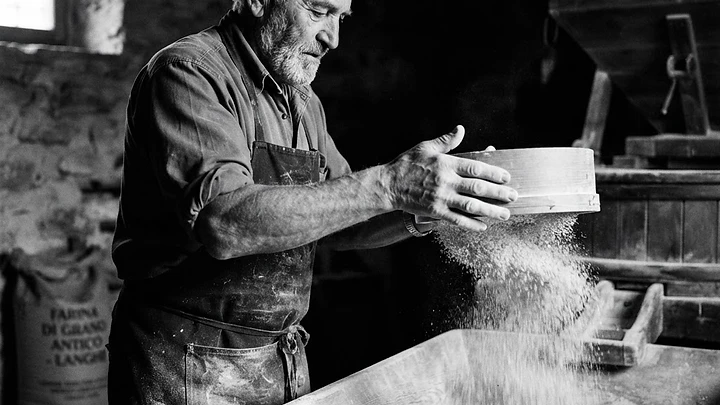
I met Piero, a miller in Monchiero, while searching for a flour that could withstand an encounter with seaweed and dashi without losing its character. He mills with granite stones at a slow pace, 40-60 kg/hour, keeping the flour temperature below 38°C; this prevents the denaturation of enzymes and preserves the earthy aromas of the germ. He works with Piedmontese ancient grains — Gentil Rosso, Risciola, Inverno — milling them whole before sifting at 180 microns to separate the coarse bran without removing the germ. The result is a flour with a low W value (160-180), low in gluten but rich in flavor, perfect for doughs that do not require much leavening but must tell the story of the grain.
With this flour, I construct a hybrid soba: 60% stone-milled ancient grain flour, 40% buckwheat flour, 38% hydration, hand-kneaded for 12 minutes until the structure is smooth but not elastic — the low gluten content demands this; there is no need to force it. After a 30-minute rest covered, it is rolled out to 2 mm and knife-cut into 3 mm tagliatelle. Cooking is brief, 90 seconds in vigorously boiling water, because the low gluten strength does not forgive long cooking times: it will disintegrate. The dashi made from kombu and dried shiitake mushrooms becomes the contrasting liquid: a cold extraction for 8 hours, followed by a slow temperature increase to 60°C for 20 minutes without ever reaching a boil, otherwise the kombu releases bitterness and unwanted mucilage.
I filter it using a cotton cloth, not a fine strainer, to leave a minimum of body. This broth marries with the toasted ancient grain flour: the light dry roast I perform in a pan, 90 seconds over medium heat before kneading, enhances hazelnut notes that the umami dashi balances without masking. For the final dish, I add scallops seared for 45 seconds per side on a 220°C griddle, just enough to create a Maillard crust while keeping the center raw and translucent, and an emulsion of black sesame oil and yuzu juice in a 3:1 ratio, whisked cold with a splash of the soba cooking water to stabilize it. Piero's flour here is not merely a background: it is an aromatic structure that holds its own against strong flavors like kombu and yuzu without disappearing.
Practical advice: if you are working with stone-milled whole grain flours with a low strength index, do not try to compensate with long kneading or double leavening — respect short resting times (20-30 minutes) and rapid cooking, letting the grain speak, rather than classical baking technique.
Have you read today's daily?Read it hereFirma del Cuoco
Chef GodeauSartoria Gastronomica
You may also like


Produttori
The Andalusian Gardener: Olive Oil as a Bridge Between Two Coasts
How a small Andalusian producer taught me to treat EVO as a dashi, cold-extracting it and using it to bind seafood dishes in an oriental style.
13 Oct 2026

Produttori
The Miller and the Dust of Time
There is no bread that does not guard the memory of the grain that was once seed, then wheat, and then silence between the stones.
3 Oct 2026


viaggi
San Sebastián: a half-day between pintxos and Basque tradition
A sensory journey through the alleys of the Parte Vieja and the flavors of the Atlantic
19 Oct 2026