Produttori
The Miller and the Dust of Time
There is no bread that does not guard the memory of the grain that was once seed, then wheat, and then silence between the stones.
3 October 2026
143 readers
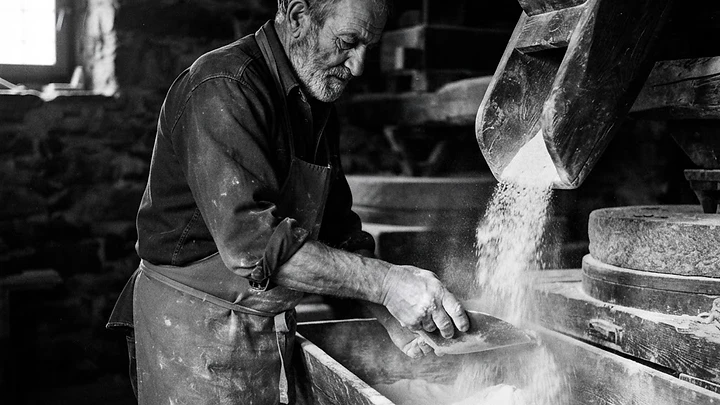
I met the miller of the Langhe on an autumn morning, when the fog was still sleeping among the rows of vines and his mill—old through generations, as faithful as a monk—was grinding slowly, almost in prayer. He showed me the ancient grain, the one our grandparents called Gentil Rosso, a kernel that progress had forgotten in a drawer of history. It is not flour, he told me, it is time rendered into dust. And I, who always seek the meeting point between East and West on the plate, saw in that slow gesture of grinding the same patience that animates the couscous of the Maghreb and the fresh pasta of Piedmont.
The Language of the Earth The Cuoco di Baghdad, in his forgotten manuscripts, wrote that bread is the primary language of the sedentary man, the pact between the earth and the hand that works it. That rough flour, the color of ancient ivory, reminded me of those pages: not domesticated by the chemistry of industrial mills, it still retains the soul of the field, the scent of the bran, a sweetness that seeks no shortcuts. Apicius, in his De re coquinaria, did not know this grain—but he knew the respect for the raw material, the idea that every ingredient carries within itself a genealogy to be honored, not erased. --- I kneaded that flour with sea water and algae, in a gesture that is a dialogue between mountain and ocean, between Langhe and lagoon.
The result was a dark bread, almost brown, which tasted of wet earth and briny wind alike—a synthesis that only the encounter between two distant worlds can generate. The miller, observing the dough rising, told me that ancient grain needs time, it will not be hurried: it is a lesson that applies as much to bread as it does to life. In my Sartoria Gastronomica, where every dish is tailored like a garment for the soul, this flour has become a precious thread. I wove it with nori seaweed leaves, with black sesame seeds brought from distant routes, in a bread that is at once East and West, root and horizon.
It is not innovation for its own sake: it is restitution, a way of making present what time had cast aside. I always return, in the moments of silence in the kitchen, to that foggy morning among the stones of the mill. The miller of the Langhe taught me that ancient flour is not nostalgia, but resistance—resistance of taste, of biodiversity, of peasant memory against the oblivion of homogenization. And so I think that cooking, ultimately, is nothing other than this: gathering what time has forgotten, and returning it to the table as an act of fidelity.
The bread that is born from that ancient grain does not only nourish the body, but mends—as tailoring does—the tear between what we were and what we risk forgetting we are.
Have you read today's daily?Read it hereFirma del Cuoco
Chef GodeauSartoria Gastronomica
You may also like

Produttori
The Andalusian Gardener: Olive Oil as a Bridge Between Two Coasts
How a small Andalusian producer taught me to treat EVO as a dashi, cold-extracting it and using it to bind seafood dishes in an oriental style.
13 Oct 2026

Produttori
The Langhe Miller and Ancient Grain Flour
How stone-milling varieties like Gentil Rosso and Risciola changes the hydration, roasting, and structure of a vegetable-marine soba.
3 Oct 2026

viaggi
San Sebastián: a half-day between pintxos and Basque tradition
A sensory journey through the alleys of the Parte Vieja and the flavors of the Atlantic
19 Oct 2026